


ชุดที่ 01 · Cells & Human Body Systems | เซลล์และระบบในร่างกายมนุษย์ (50 ข้อ)
✍️ ฝึกทำ เห็นผลทันทีเมื่อส่ง

ตะลุยข้อสอบ: ชุดที่ 01 · Cells & Human Body Systems | เซลล์และระบบในร่างกายมนุษย์ (50 ข้อ)
ตอบทีละข้อ ส่งแล้วเห็นคะแนน เฉลยละเอียด และเทียบกับผู้สอบคนอื่น · ตอบถูกติดกันได้คอมโบ ×2 ×3
50 ข้อ
 สูงสุด +730
เลือกโหมดการทำข้อสอบ
1. รูปแบบ
2. การเฉลย
ตัวอักษรที่อ่านสบายสำหรับคุณ
ขนาด
ทดลองทำฟรี ไม่ต้องสมัครสมาชิกส่งแล้วเห็นคะแนนและเฉลยทุกข้อทันที · สมัครฟรีภายหลังเพื่อบันทึกผล รับเหรียญ MVP และขึ้นตารางอันดับ
ข้อ 1 / 50
⏱ 00:00
✓ 0✗ 0
Aa
ขนาด
1
The figure shows a plant cell as seen under a light microscope.
Which labelled part is made mainly of cellulose and gives the plant cell a fixed shape?
Which labelled part is made mainly of cellulose and gives the plant cell a fixed shape?

2
The figure shows a plant cell.
Which TWO labelled structures would also be found in a human cheek cell?
Which TWO labelled structures would also be found in a human cheek cell?

3
The figure shows an animal cell.
In which labelled part does aerobic respiration mainly take place, releasing energy from glucose?
In which labelled part does aerobic respiration mainly take place, releasing energy from glucose?

4
The figure shows a compound light microscope.
A specimen has been focused using the low-power objective. The student then turns the high-power (40×) objective into position. Which labelled part should the student turn to make the image sharp?
A specimen has been focused using the low-power objective. The student then turns the high-power (40×) objective into position. Which labelled part should the student turn to make the image sharp?

5
A student views cheek cells using a 10× eyepiece and a 40× objective lens. The image of one cell measures 12 mm across. What is the actual width of the cell?
6
A student is observing onion cells with the 10× objective lens and then changes to the 40× objective lens without adjusting the light. What change in the view is expected?
7
Under a compound light microscope, the cell that a student wants to study appears in the upper-right part of the field of view. In which direction should the student move the slide on the stage to bring the cell to the centre of the field of view?
8
Which list shows the levels of organisation in the human body in order from the SMALLEST to the LARGEST?
9
Which of the following is a tissue rather than an organ?
10
Which of the following is an example of diffusion rather than osmosis?
11
The figure shows an experiment. A bag of Visking tubing (a partially permeable membrane) containing 5% sucrose solution is attached to a capillary tube and placed in a beaker of 20% sucrose solution.
What will happen to the liquid level in the capillary tube after 30 minutes?
What will happen to the liquid level in the capillary tube after 30 minutes?

12
Potato cylinders, each with a starting mass of 5.00 g, were placed in sucrose solutions of different concentrations for 2 hours. They were then dried and weighed again. The results are shown in the table.
Between which two concentrations of sucrose solution would a potato cylinder neither gain nor lose mass?
Between which two concentrations of sucrose solution would a potato cylinder neither gain nor lose mass?

13
Some red blood cells and some onion epidermis cells are placed separately in distilled water for 20 minutes. Which statement correctly describes what happens to the cells?
14
Slices of cucumber are sprinkled with salt. After 15 minutes, water collects on the plate and the slices become soft. When a thin piece of the cucumber is examined under a microscope, what would most likely be seen in its cells?
15
Which pair of substances are the raw materials that a green plant uses for photosynthesis?
16
A potted plant with variegated leaves was kept in the dark for 48 hours and then placed in bright light for 6 hours. One leaf was removed and tested for starch using iodine solution. The figure shows the leaf before the test.
Which result and conclusion are correct?
Which result and conclusion are correct?

17
The figure shows an experiment with a water plant (Hydrilla). A lamp was placed at different distances from the plant, and the number of gas bubbles released per minute was counted. The water temperature was kept constant.
Which conclusion is best supported by the results?
Which conclusion is best supported by the results?

18
The figure shows an experiment. Flask A contains germinating seeds and flask B contains the same number of boiled seeds. Both sets of seeds were first rinsed in disinfectant to kill microorganisms. The air in each flask is connected to a test tube of limewater.
What is the expected result after several hours, and what does it show?
What is the expected result after several hours, and what does it show?

19
Which statement about photosynthesis and respiration in a green plant is correct?
20
During a 100-metre sprint, a runner's leg muscles cannot get enough oxygen. Which describes the respiration taking place in the muscle cells?
21
The figure shows part of the human digestive system.
Which correctly identifies where bile is produced and where it is stored?
Which correctly identifies where bile is produced and where it is stored?

22
The figure shows part of the human digestive system.
In which labelled part is most digested food absorbed into the blood?
In which labelled part is most digested food absorbed into the blood?

23
Which row correctly matches a digestive enzyme with the food it digests and the products formed?
24
Four test tubes were set up as shown in the table. After 15 minutes, a drop from each tube was tested with iodine solution.
In which tube(s) would the iodine solution most likely stay yellow-brown?
In which tube(s) would the iodine solution most likely stay yellow-brown?

25
The table shows four test tubes set up to investigate the enzyme amylase. After 15 minutes, the contents of each tube were tested with iodine solution.
What can be concluded by comparing the results of tube 2 and tube 3?
What can be concluded by comparing the results of tube 2 and tube 3?

26
A student carried out three food tests on a sample of food. The table shows the results.
Which conclusion is correct?
Which conclusion is correct?

27
Which food test is correctly matched with its positive result?
28
The figure shows the nutrition label of a cereal bar. 1 g of fat releases 9 kcal, and 1 g of carbohydrate or protein releases 4 kcal.
About what percentage of the energy in one bar comes from fat?
About what percentage of the energy in one bar comes from fat?

29
Which nutrient deficiency is correctly matched with the condition it causes?
30
The figure shows a section through the human heart, viewed from the front.
Which labelled chamber has the thickest muscular wall?
Which labelled chamber has the thickest muscular wall?

31
The figure shows a section through the human heart, viewed from the front.
Deoxygenated blood returning from the body through the vena cava enters which labelled chamber first?
Deoxygenated blood returning from the body through the vena cava enters which labelled chamber first?

32
Which sequence correctly shows the path of blood from the lungs to the rest of the body?
33
A blood vessel has a thin wall, a wide lumen and valves along its length. It carries blood at low pressure. What type of blood vessel is it, and in which direction does it carry blood?
34
Which blood vessel carries deoxygenated blood away from the heart?
35
Which component of blood is correctly matched with its function?
36
The graph shows the heart rate of a student before, during and after running. The shaded area shows the time when the student was running.
How long after the student stopped running did it take for the heart rate to return to the resting rate?
How long after the student stopped running did it take for the heart rate to return to the resting rate?

37
Nida counts her pulse at her wrist and finds 18 beats in 15 seconds. What is her heart rate in beats per minute?
38
The figure shows a model of the human breathing system.
When the rubber sheet is pulled down, what happens?
When the rubber sheet is pulled down, what happens?

39
Which correctly describes what happens when a person breathes in (inhales)?
40
The figure shows gas exchange between an alveolus and a blood capillary in the lungs. Arrows X and Y show the movement of two gases.
Which correctly identifies gases X and Y?
Which correctly identifies gases X and Y?

41
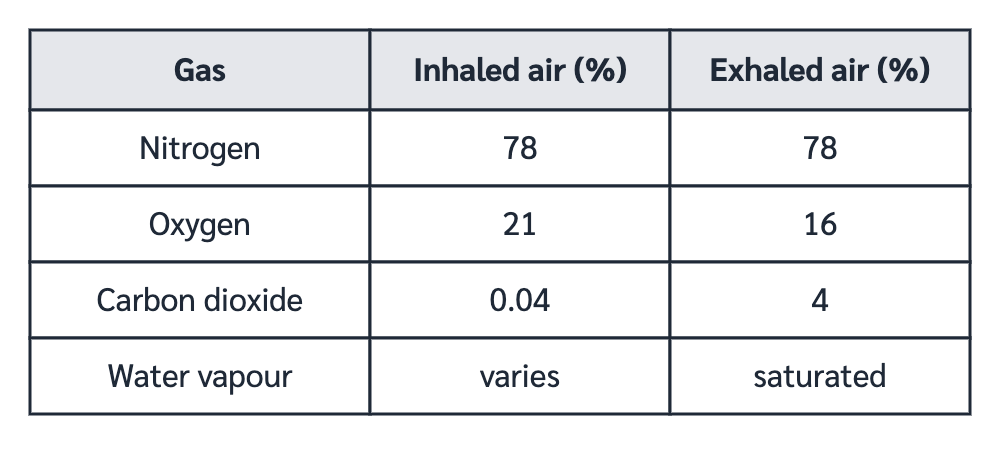
The table shows the composition of inhaled and exhaled air.
Which statement is supported by the data in the table?
Which statement is supported by the data in the table?
42
The figure shows the human urinary system.
Which sequence shows the correct path of urine from where it is made until it leaves the body?
Which sequence shows the correct path of urine from where it is made until it leaves the body?

43
Glucose is filtered out of the blood in the kidneys, yet the urine of a healthy person contains no glucose. Which is the best explanation?
44
A boy accidentally touches a hot pan and pulls his hand away before he feels any pain. Which sequence shows the pathway of this reflex action?
45
After a head injury, a man has difficulty keeping his balance, and his movements are poorly coordinated. His breathing, memory and speech are normal. Which part of the brain is most likely damaged?
46
After a meal rich in carbohydrates, the glucose level in a person's blood rises. Which hormone is released, and from which organ, to bring the blood glucose level back to normal?
47
Which endocrine gland is correctly matched with a hormone it produces and the effect of that hormone?
48
Which change during puberty is caused mainly by the hormone oestrogen?
49
The figure shows the female reproductive system.
In which labelled part does fertilisation normally take place?
In which labelled part does fertilisation normally take place?

50
Which statement about vaccination is correct?
🏆
0%0/0
+0 เหรียญ MVP ที่ได้
เหรียญ MVP ที่ได้-เวลาที่ใช้
-อันดับรวม
-เทียบครั้งก่อน
อันดับบทนี้ (นับครั้งแรกของแต่ละคน)


